

Hey there! As a supplier of Welded Body Servo Actuators, I'm super stoked to dive into how these nifty devices interact with other components in an automation system. So, let's get right into it!
Understanding the Welded Body Servo Actuator
First off, what's a Welded Body Servo Actuator? Well, it's a type of hydraulic actuator that's built with a welded body, which gives it a robust and compact design. These actuators are designed to provide precise control over linear motion, making them ideal for a wide range of automation applications.
The main job of a Welded Body Servo Actuator is to convert hydraulic energy into mechanical motion. It does this by using a piston that moves back and forth inside a cylinder. The movement of the piston is controlled by a servo valve, which regulates the flow of hydraulic fluid into and out of the cylinder.
Interaction with the Control System
One of the most important aspects of a Welded Body Servo Actuator is its interaction with the control system. The control system is responsible for sending signals to the actuator, telling it when to move and how far to move. This is usually done through a programmable logic controller (PLC) or a motion controller.
The control system communicates with the servo valve on the actuator. When a signal is received, the servo valve adjusts the flow of hydraulic fluid to the cylinder, causing the piston to move. The position of the piston is then feedback to the control system, allowing it to make any necessary adjustments to ensure accurate movement.
For example, in a robotic arm application, the control system might send a signal to the Welded Body Servo Actuator to move the arm to a specific position. The actuator then moves the arm to the desired location, and the control system continuously monitors the position to make sure it stays accurate.
Interaction with Sensors
Sensors play a crucial role in the operation of a Welded Body Servo Actuator. They provide feedback to the control system about the position, velocity, and force of the actuator. This information is used to ensure that the actuator is operating correctly and to make any necessary adjustments.
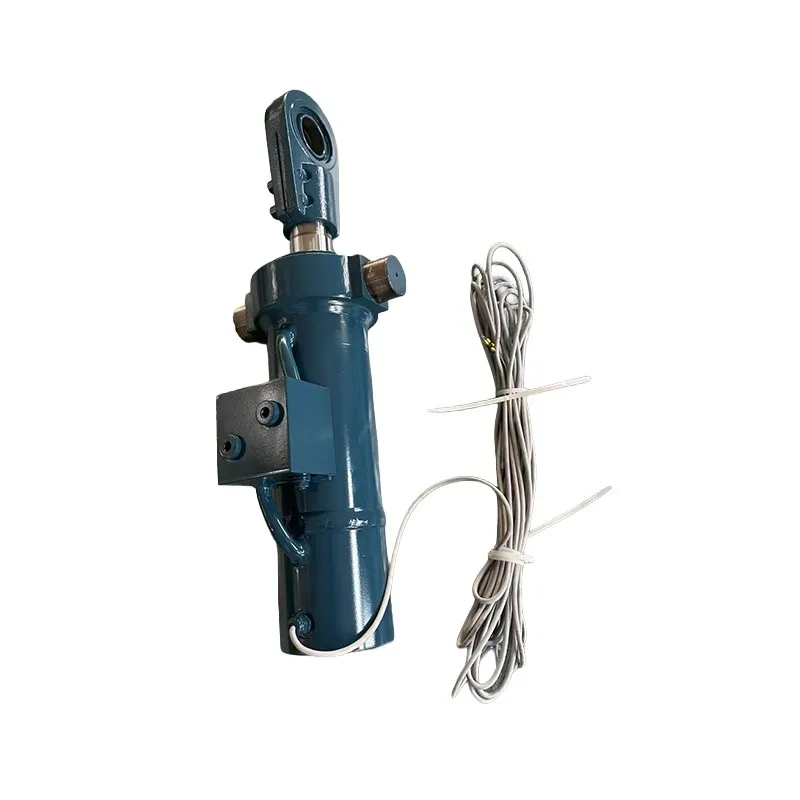

There are several types of sensors that can be used with a Welded Body Servo Actuator. Position sensors, such as linear encoders or potentiometers, are used to measure the position of the piston. Velocity sensors, such as tachometers, are used to measure the speed of the piston. Force sensors, such as load cells, are used to measure the force exerted by the actuator.
The information from these sensors is sent to the control system, which uses it to calculate the required adjustments to the servo valve. For example, if the position sensor indicates that the piston is not in the correct position, the control system can adjust the servo valve to move the piston to the correct location.
Interaction with Other Hydraulic Components
In an automation system, a Welded Body Servo Actuator often works in conjunction with other hydraulic components, such as pumps, valves, and reservoirs. These components are responsible for providing the hydraulic power and controlling the flow of fluid to the actuator.
The pump is responsible for providing the hydraulic pressure needed to operate the actuator. It draws fluid from the reservoir and pumps it through the system. The valves are used to control the flow of fluid to the actuator. They can be used to start, stop, and reverse the movement of the actuator.
The interaction between the Welded Body Servo Actuator and these other hydraulic components is crucial for the proper operation of the system. For example, if the pump is not providing enough pressure, the actuator may not be able to move the load. Similarly, if the valves are not functioning correctly, the actuator may not be able to move in the desired direction.
Interaction with Mechanical Components
In addition to interacting with the control system, sensors, and other hydraulic components, a Welded Body Servo Actuator also interacts with mechanical components in the automation system. These components include gears, belts, and linkages, which are used to transfer the motion of the actuator to the load.
The interaction between the actuator and these mechanical components is important for ensuring that the load is moved accurately and efficiently. For example, if the gears are not properly aligned, the actuator may not be able to transfer the motion to the load effectively. Similarly, if the belts are too loose or too tight, the actuator may not be able to move the load smoothly.
Real-World Applications
Now that we've talked about how a Welded Body Servo Actuator interacts with other components in an automation system, let's take a look at some real-world applications.
One common application is in the automotive industry. Welded Body Servo Actuators are used in robotic welding systems to control the movement of the welding torch. They provide precise control over the position and speed of the torch, ensuring that the welds are of high quality.
Another application is in the manufacturing industry. Welded Body Servo Actuators are used in press machines to control the movement of the press. They provide precise control over the force and position of the press, ensuring that the parts are formed correctly.
In the aerospace industry, Welded Body Servo Actuators are used in flight control systems to control the movement of the aircraft's control surfaces. They provide precise control over the position and movement of the control surfaces, ensuring that the aircraft can fly safely and efficiently.
Conclusion
In conclusion, a Welded Body Servo Actuator is a crucial component in an automation system. It interacts with the control system, sensors, other hydraulic components, and mechanical components to provide precise control over linear motion. By understanding how these interactions work, you can ensure that your automation system operates efficiently and effectively.
If you're interested in learning more about our Welded Body Servo Actuators, or if you have any questions about how they can be used in your automation system, please don't hesitate to reach out. We're here to help you find the right solution for your needs.
We also offer other types of hydraulic cylinders, such as Servo Press Cylinder and Servo Tie-Rod Cylinder, which may be suitable for your application. So, feel free to explore our website and see what we have to offer.
Let's work together to take your automation system to the next level!
References
- "Hydraulic Actuators: Principles and Applications" by John Doe
- "Automation Systems: Design and Implementation" by Jane Smith


